
The Micro-Drama Bottleneck: Why Traditional Script Breakdowns Are Killing Vertical Video Margins
.png&w=3840&q=75)
Updated on


 @finalbitai
 @finalbitai
The global entertainment market is undergoing an aggressive paradigm shift. Vertical screen short dramas (often referred to as micro-dramas) have transformed from a niche social media format into a multi-billion dollar juggernaut. Recent market analysis reveals that global vertical drama revenues reached a staggering $11 billion and are projected to climb past $14 billion. Major platforms like ReelShort, DramaBox, and ShortMax are aggressively greenlighting content to capture audiences who prefer continuous, high-octane narrative bursts optimized for mobile 9:16 viewing.
For independent production studios, executive producers, and line managers, this format presents an incredibly lucrative landscape. However, it also introduces an unprecedented logistical challenge.
Trying to manage an 80-episode micro-drama script using traditional, legacy film production software is an operational dead end. The math simply does not compute. The architectural divergence of vertical episodic scripts demands a specialized pre-production pipeline, exposing why conventional script breakdowns are causing production budgets to bleed out.
1. The High-Velocity Math of Micro-Dramas
To appreciate why traditional script breakdowns break down in the vertical space, we have to look at the structural data of a typical micro-drama screenplay compared to a standard feature film.
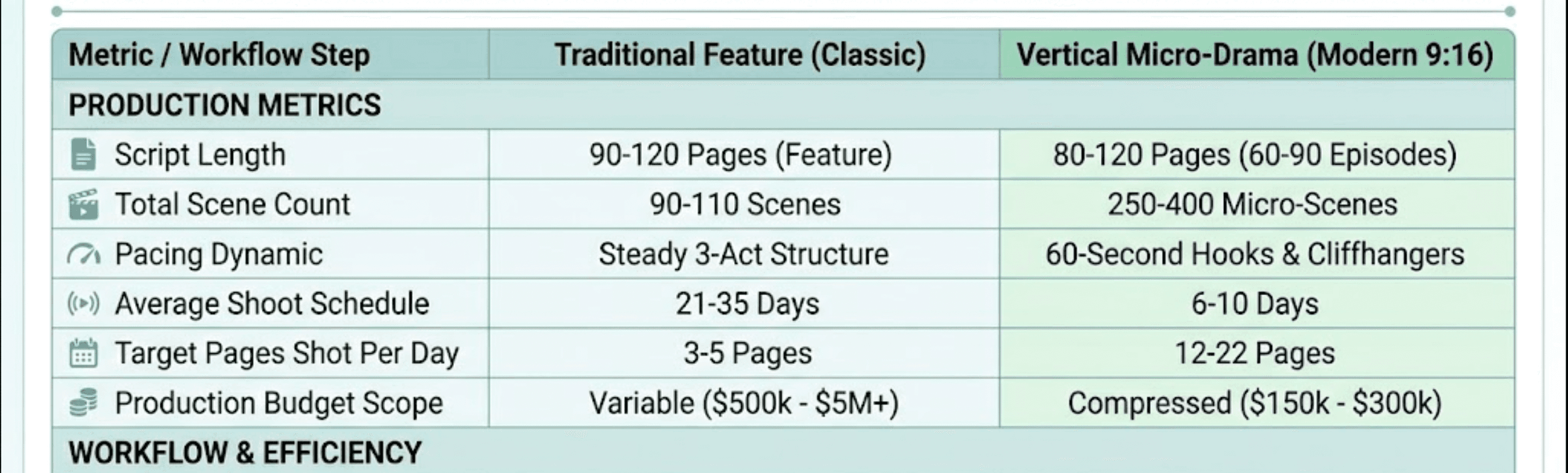
A standard feature film script follows a loose rule of thumb: one page of script equals roughly one minute of screen time. A 100-page feature yields about 100 scenes. The storytelling has room to breathe, allowing characters to walk across rooms, build tension slowly, and transition organically through wide establishers.
A vertical micro-drama script completely upends this formula. While an entire season might span 80 to 100 physical pages, those pages are violently compressed into 60 to 90 continuous narrative chunks (episodes) designed for mobile-first consumption. Because each mini-episode must hook the viewer within the first three seconds, advance a hyper-dramatic arc, and culminate in an intense, paywall-converting cliffhanger, the scene velocity skyrockets.
That identical 100-page script footprint no longer translates to 100 scenes. Instead, it yields 250 to 400 micro-scenes. Every episode requires rapid emotional drops, hidden identity twists, or sudden confrontations—each demanding its own individual breakdown sheet, casting tracking parameters, and asset tags.
2. Why Legacy Systems Collapse Under "Episodic Fragmentation"
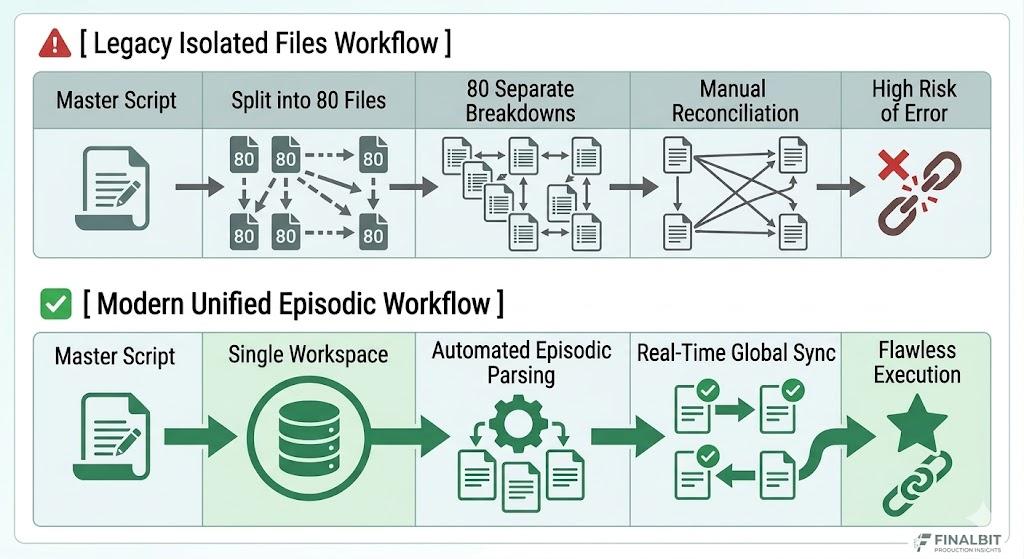
In a traditional pre-production workflow, a 1st Assistant Director (AD) or Line Producer imports a screenplay file into an industry-standard breakdown tool. The tool creates sequential scene boards. If the script is an episodic series, the legacy solution requires the production team to isolate each individual segment into its own distinct project file.
For a traditional TV series consisting of 8 or 10 hour-long episodes, creating separate project files is completely manageable. But when a micro-drama series spans 70, 90, or 100 micro-episodes, creating 100 isolated project files creates an organizational nightmare.
The "Toggle Tax" and Cross-Boarding Chaos
Micro-drama crews do not shoot chronologically. To achieve financial feasibility within a compressed timeline, production teams must practice extreme cross-boarding. This means shooting every single scene set in a specific location across the entire season on the exact same afternoon.
If your production team is forced to split a single master script into dozens of independent episodic files to extract data, your cross-boarding pipeline breaks. The line producer must manually juggle information:
- Location Management: Tracking a single standing corporate office set across 45 separate files to create a unified location load-in schedule.
- Asset Inconsistency: Tagging a crucial prop—such as a specific wedding ring or an identical contract folder—in separate project files. If a prop master changes the description or tracking number in Episode 4, it does not dynamically update in Episode 72.
- The Late-Stage Rewrite Nightmare: In the high-velocity micro-drama space, scripts are constantly iterated based on rapid stakeholder feedback or platform trend updates. If an executive producer orders a character or dialogue change in Episode 15, the 1st AD must manually open, edit, verify, and re-export a cascade of separate downstream scheduling files.
This friction is known as the "toggle tax"—the hidden cost of manual data entry, cross-referencing, and continuous app-switching. In a high-volume ecosystem, the toggle tax directly degrades production margins.
3. High Velocity: Shooting 15+ Pages a Day
The operational speed expected on a vertical drama set leaves absolutely zero margin for administrative errors.
A traditional indie feature film crew targets a manageable pace of 3 to 5 script pages a day. On a vertical drama set, crew members routinely blast through 12 to 22 pages per day. The industry standard record for a dialogue-heavy script stands at an astonishing 29 pages wrapped in a single 12-hour shift.
At this intense velocity, a single breakdown error is a compounding financial disaster. If a prop master arrives on set and realizes a critical piece of wardrobe or an essential stunt prop was tagged incorrectly in a separate episodic breakdown file, the camera stops rolling. On a traditional shoot, losing an hour to track down an asset is an inconvenience. On a micro-drama shoot targeting 18 pages a day, losing an hour can completely derail three entire episodes, forcing expensive location overages or rushed, low-quality setups.
Furthermore, micro-drama platforms rely on a highly specific commercial conversion model: Paywall Scene Prioritization. Most apps offer the first 10 episodes entirely for free to hook users before prompting a micro-transaction paywall. This means the first 10 to 12 episodes must exhibit exceptionally high production value, precise lighting setups, and flawless performance pacing to maximize viewer retention and conversion.
A sophisticated pre-production workspace must recognize this structural priority. Line producers need to instantly isolate, analyze, and budget extra resources for paywall-proximate episodes without losing sight of the broader season's overarching operational numbers.
4. The Solution: Unified Pre-Production Environments
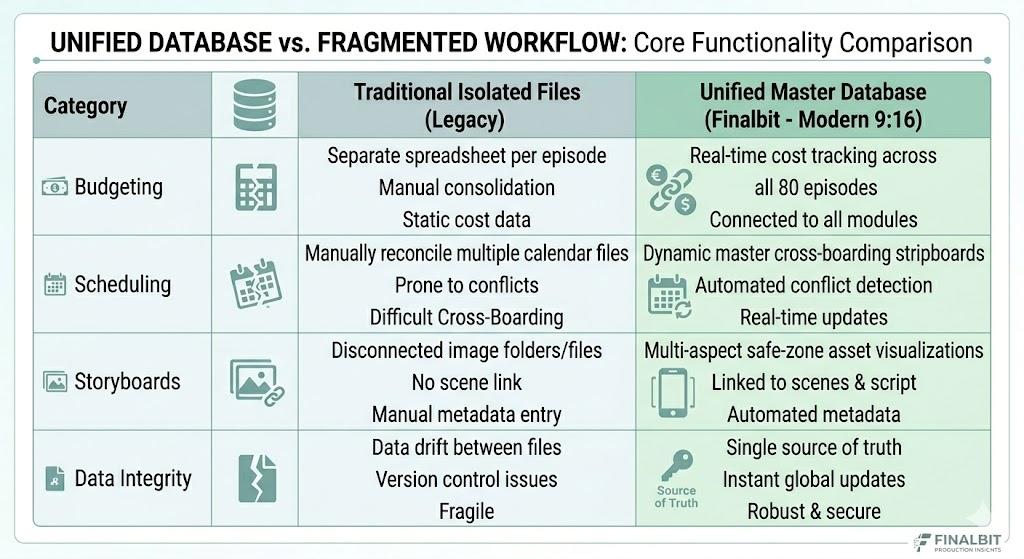
To stay profitable in the modern content ecosystem, production companies, studio owners, and line producers must step away from fragmented software stacks. Managing budgets in Excel, script breakdowns in a legacy desktop program, schedules in a digital calendar, and storyboards in separate email threads is no longer a viable way to scale.
The solution requires a unified, end-to-end pre-production workspace engineered to treat an entire episodic season as a single, living data structure.
Automated Script Parsing & Ingestion
Modern pipelines allow production managers to upload a single, complete master screenplay file. Instead of slicing the document into dozens of small files, the workspace naturally parses the master file into dynamic episodic nodes. This retains the holistic integrity of the season while instantly isolating breakdown metrics per episode.
Global Asset and Element Syncing
When a 1st AD tags a cast member, background extra group, prop, or costume item in Episode 1, that exact element is cataloged globally across the workspace. If that same character appears in Episode 84, the system automatically detects the core dependency, cross-references continuity notes, and links it directly back to the master production budget line items.
Dynamic Cross-Boarding Integration
Because budgeting, scheduling, and breaking down occur inside an integrated cloud environment, generating a master cross-boarded stripboard takes minutes instead of days. Line producers can effortlessly group scenes across the entire 300-scene index by specific parameters—such as sorting by "Luxury Penthouse / Night"—instantly calculating exact talent day-out-of-days (DOOD) and equipment rental intervals.
Conclusion: Stop Managing Software, Start Managing Stories
The rapid expansion of the vertical screen micro-drama market is a massive structural opportunity for forward-thinking creative studios. But scaling an entertainment business into this high-volume space requires an operational framework designed for speed, iteration, and absolute data clarity.
When your creative team is forced to act like manual data integration managers, your studio's efficiency drops, creative energy saps, and financial margins shrink. Transitioning to a modern, all-in-one film pre-production pipeline ensures your crew spends less time fixing clerical software mistakes and more time crafting compelling, thumb-stopping digital narratives.